
About
There is a wrong way and a right way and the important thing is to do it the right way. Doing it the wrong way means. Means. You don’t want to know.
There is always an order to the courses. One- An outside world that holds beauty and harm. Two- A mother and her three children. Three – lessons taught, lessons remembered. There is an order to the courses, an order to the place setting, an order to life, and how much of it you can live. Order protects us– it must. But memory refuses to serve.
Cast & Creatives
Written by Hillary Gao
Performed by: Sharon Sakai
Music: Riyaaz Ray Vachani
Costume Design: Dan Wang
Movement Direction: Mars Garcia
Assistant Director/Creative Consultant: Elizabeth Crawford
Line Producer: Leigh Honigman
Dramaturgical Consultant: Annie Jin Wang
Stage Manager/Lighting Designer: Celine Abdallah
Graphic Designer: Lucy Chi
Video/Photo: Lauren Chiriboga
Understudy: Rita Liu
Community Discussion

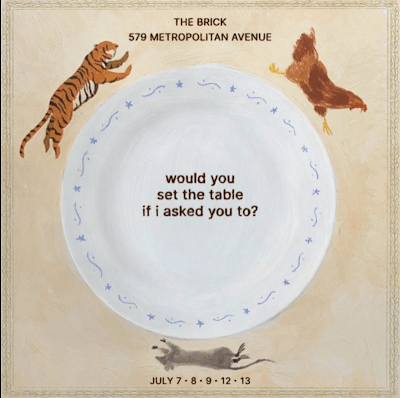
Would you sit at a strangely uneven table if someone asked you to? Entering The Brick, I received encouragement to “sit at the table.” I found a well-lit bright red table enticing me to sit despite a questionably stable surface. Friendly folks around it beckoned me to join, brushing away any qualms. Riyaaz Ray Vachani’s cello playing suggests a dinner party, encouraging mingling before the beginning of would you set the table if I asked you to? As such, I recommend arriving early, especially if you’d like a seat at the table for five—though most seats are in the round. Chats suddenly become punctuated by animal sounds as Miranda Kang, Ring Yuqi Yang, and Shan Y. Chuang leap into the space, embodying a tiger, chicken, and mouse. Accompanying them is Sharon Sakai as their mother, imparting poetic parental advice on how to survive—albeit unobtrusively. Fitting what the late, great Ntozake Shange called a choreopoem, the show’s virtuosity lies in its interlocking forms. The live music punctuates the cast members artfully embodying Mars Garcia’s precise yet playful choreography. Sharon Sakai impressively backs them up, bearing the lion’s share of Hillary Gao’s poetry rhythmically and soothingly. When the dramatic momentum slowed after the imparting of said parental advice, I simply let the vibrant words and choreography wash over me as it occurred mere inches from my seat. As such, I don’t know if I would have enjoyed this middle course as much had I not sat at the table (or if the show was more than an hour). But in the third course, when the cutlery came out, so too did the figurative sharp knives of the show’s ideas make themselves apparent. The parental advice did not go as planned. Those who hope for a juicy plot may come away hungry. But poetry fans will devour the rich language, wordplay, and themes. The show serves up concepts of tradition, expectation, familial obligation, and etiquette, wrapped in motifs of animalistic claws, jaws, and teeth, vying for success. The majority AAPI cast and crew raise questions that may resonate with children of immigrant parents—or anyone worried about an increasing generational divide. What happens when advice turns out to be wrong? What if you follow every instruction? And, literally and figuratively, what does it mean to have a seat at a table that isn’t built how you expected?