
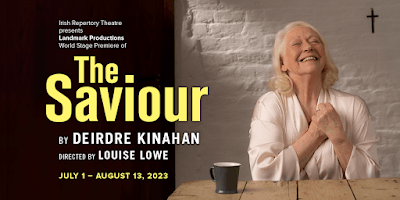
About
There’s a new man in Máire’s life. But some people aren’t happy.
On the morning of her 67th birthday, Máire sits up in bed enjoying a cigarette. She has recently been swept off her feet by a stranger and hasn’t felt this alive in years, but a visit from her son with dark revelations challenges the euphoria.
Deirdre Kinahan’s fiercely funny and utterly gripping new play charts an extraordinary shift in Ireland’s social, political, and religious life. It asks questions about responsibility, how we respond to trauma, and the tricky question of forgiveness.
It stars legendary Irish actress Marie Mullen (The Music Man, Broadway; The Beauty Queen of Leenane, Druid, for which she won a Tony Award) in a tour-de-force performance. She is joined by Jamie O’Neill in this riveting two-hander directed by one of Ireland’s leading theatre directors, Louise Lowe.
Cast & Creatives
By Deirdre Kinahan
Directed by Louise Lowe
With Marie Mullen and Jamie O’Neill
Community Discussion

"The Savouir" Irish playwright Deidre Kinahan's new two-hander, "The Savouir," opens with an elderly woman smoking in her bed. It's Maire's 67th birthday, and she is enjoying her morning bathed in postcoital glory, having been instructed by her lover, Martin, to wait for him to get coffee. Played by legendary Irish powerhouse Marie Mullen, who won the 1998 Tony Award for Best Actress in the original Broadway production of "Beauty Queen of Leeanne" and co-founded the birthplace of that production, Druid Theater, in 1975, it is a delightful treat to see her on the New York stage. In this Landmark Productions show presented by Irish Repertory Theater on 21st St, Mullen's Marie starts with a lengthy monologue that covers a lot of background, from Martin to her dead husband Colm, her childhood at the convent, and her intense devotion to Jesus. Kinahan very smartly adopts the staging convention of a monologue in a naturalistic setting, meaning it is always staged as if the character is talking to the audience. Mullen is on stage by herself for a good 20 minutes, delivering a monologue that gives the character's background story and intensifies her religious devotion. There are plenty of naughty, sexy bits here, and it is a joy to see Mullen devouring the text, relishing those moments by chewing through the words. We are all so happy for this woman, who clearly had a rough upbringing among the nuns and still misses her dead husband but is now able to rejoice in a newfound passion during her twilight years. It is rare to see an elder character represented this way on any stage, let alone when portrayed by Mullen, who shines through some pretty heavy-handed directorial choices (spotlight and eerie music cues to tell the audience "pay attention to this part!") made by director Louise Lowe. These euphoric delights soon meet a violent end when her son Mel shows up with an awkward birthday gift and urgent news. The subject here is pedophilia, not an unfamiliar theme among contemporary Irish plays, and Martin has "just been released after 8 years." There is no social commentary thread to this plot point; rather, it serves to mark Marie's delusion. From refusing to believe her son to granting Martin forgiveness because they are both "good Christians," we see Marie quickly unravel in front of her son. When Mel tries to figure out whether Martin had spent any time alone with his nieces in the house, she accuses her son of not seeing them as full women. Kinahan's fiercely exchanged dialogue throws Marie's entire monologue into a different context. We see that her version of the story might not be the whole truth and that her delusional state has stemmed from her religious upbringing. This becomes intensely apparent during her accusation of Mel, who turns out to be gay (where the play feels more crafty than a real event). Eventually, Mel has to withdraw from the conversation, abandoning his mother, which is a relief since I don't think any audience members can tolerate any more of Marie's tirades (Jamie O'Neill takes it all sheepishly, with comical turns). Back by herself again, Marie is troubled by something else beyond Martin. In a plot twist for a secular atheist like me, Kinahan points to the root of Marie's delusion. It is a smart ending that lifts up some previously contrived moments. The true draw here is Mullen, who delivers an outstanding performance as a matriarchal doomsday nightmare that would be enough to make Tennessee Williams flee the theater.