
About
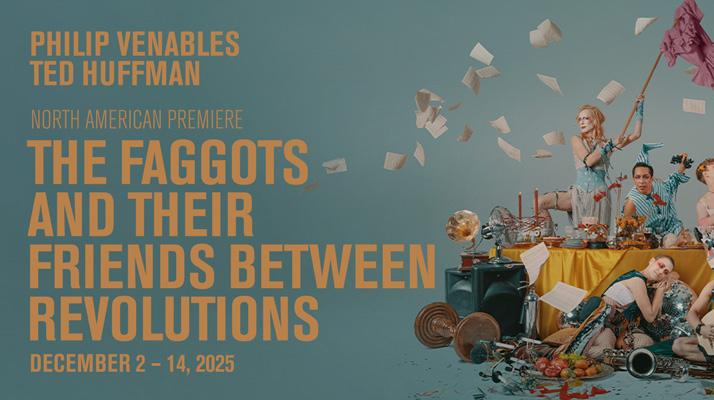
“It’s been a long time since the last revolutions and the faggots and their friends are still not free.” Published in 1977, this passage from Larry Mitchell and Ned Asta‘s The Faggots and Their Friends Between Revolutions sets the scene for a radically reimagined history of the world told through a queer lens where fantasy meets liberation. Having become unavailable and reissued on the occasion of the fiftieth anniversary of the Stonewall riots because of its enduring relevance, this cult book of fables and myths serves as the starting point for a new music theater adaptation from the creative minds of composer Philip Venables and director Ted Huffman.
Together they conjure up a world that takes the original text on a kaleidoscopic journey that ignores boundaries just like the characters on stage do, drawing on theater, dance, and song from the Baroque to Broadway and beyond. The performers serve as actors, storytellers, and musicians all rolled into one, continually swapping roles while doing away with gender and genre norms and replacing them with unapologetic individuality and a lust for life. Their deeply personal stories prove both comforting and healing when shared through community in a colorful, madcap, and profound patchwork. The resulting cabaret-like spectacle is both vulnerable and daring, a fantastic parable hiding a political manifesto for survival that gives voice to the marginalized and oppressed everywhere.
Cast & Creatives
Music by Philip Venables Direction and Text by Ted Huffman Music Direction by Yshani Perinpanayagam Choreography, Costume Design by Theo Clinkard Set Design by Rosie Elnile Lighting Design by Bertrand Couderc Sound Design by Simon Hendry Dramaturgy by Scottee
Seat Views
View all 1 seat view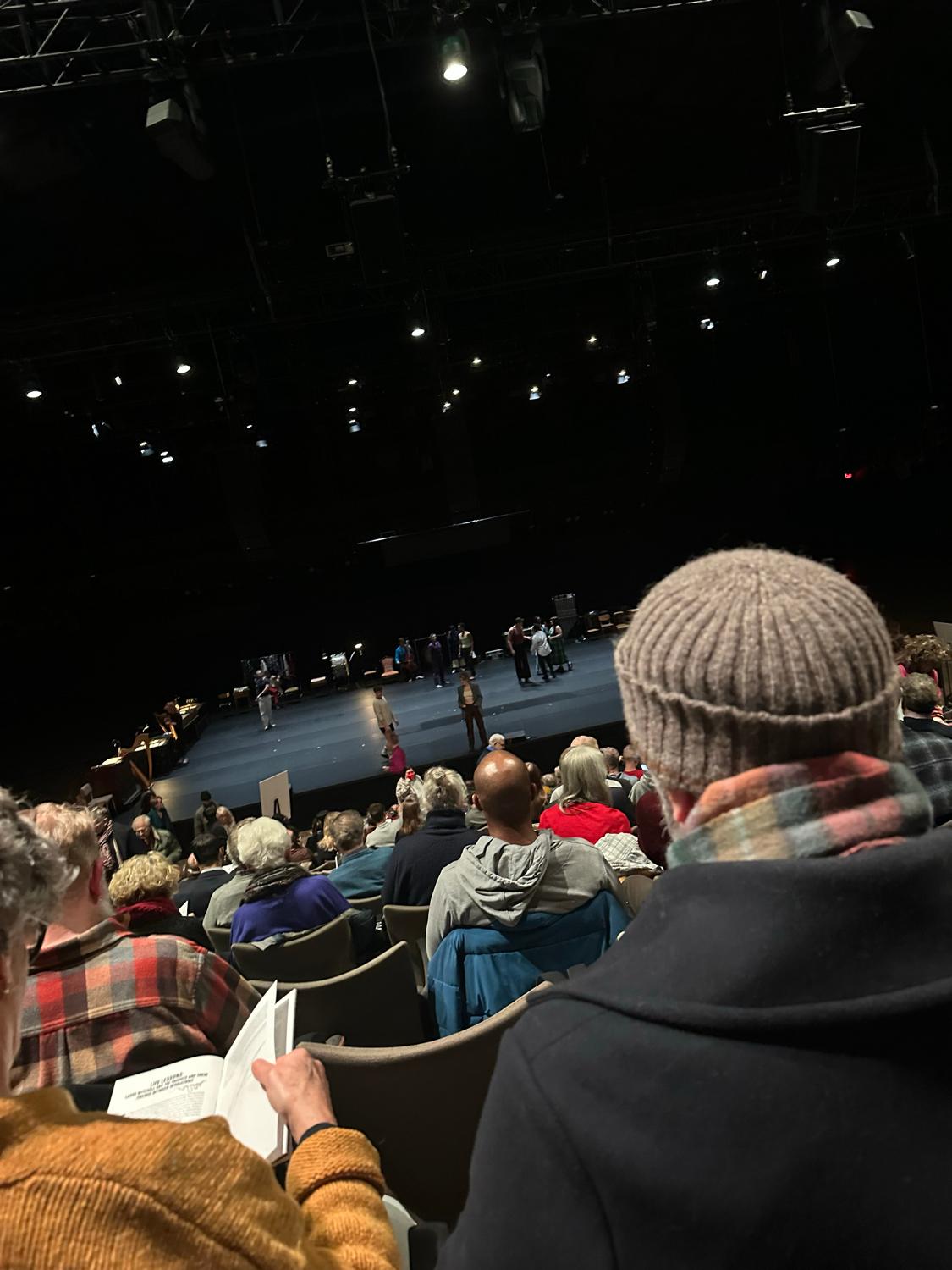
Community Discussion


 Recommend it
A poignant piece unfortunately still relevant due to the current political climate/regime. I hope this show finds a space and an audience because the messages here feel grounded in community, which is so necessary right now. Faggots unite and rejoice! Let’s start the revolution!! ✊

 Mixed feelings
This was a LOT and pretty shaggy (plus tbqh a little too operatic for my uncultured opera-hating ass) but I liked what it was trying to do. I think a lot of what I loved about it may be the words of the original book, more than this particular interpretation of them?
 Mixed feelings
Ambitious yet a little listless. Even if I got choked up

 Didn’t like it
one of the worst things i’ve ever seen
 R104
I’m honestly still trying to come back down to earth after tonight’s performance of the queer classic by Larry Mitchell and Ned Asta, The Faggots and Their Friends Between Revolutions, adapted for the stage by composer Philip Venables and director Ted Huffman. Walking out of the Wade Thompson Drill Hall at the Park Avenue Armory felt like leaving another dimension - one that was louder, queerer, more alive, and far more honest than the world outside. And first of all: the venue. Stunning. Glorious. Gasp-worthy. It’s the kind of space that makes you feel tiny in the best way, like you’ve stepped into a cathedral dedicated to art itself. And then the show starts. Venables and Huffman didn’t just adapt this 1977 queer fable, they transformed it into a full-blown theatrical cosmos. It’s opera, dance, ritual, storytelling, myth, comedy, and political theatre all woven together. They don’t warm you up; they throw you directly into the fire (lovingly). The first moment, with Mariamielle Lamagat’s voice floating through the hall, set the tone immediately. “It’s been a long time and we’re still not free” hits like an incantation. You could feel the audience collectively inhale. From there, the production becomes a sweeping queer myth-history, delivered not as a lecture but as a living, breathing celebration. Kit Green, serving as our guide and primary storyteller, somehow manages to feel both mystical and totally relatable. When she breaks the fourth wall and invites the entire audience into an unexpected sing-along, with surtitles overhead like queer opera karaoke, it becomes one of those rare theatrical moments that feels communal, chaotic, and oddly sacred. The ensemble’s musicality is unreal. Fifteen performers, each seemingly trained in every known art form, rotate between instruments: violins, cello, piano, accordion, lutes, flutes, a harpsichord, and yes, a wine glass that somehow becomes its own character. The layers of sound they build feel like a spell being cast. At certain points, the vibrations in the room were so intense that it felt like history itself was pulsing through the floorboards. And the movement…oh my gosh, the movement! Dance functions here as a language, a memory, a protest. Yandass Ndlovu, especially, commands the entire space. Their piece with the tangled cloth was deeply affecting, a symbolic shedding of centuries of shame and constraint. The silence during parts of it, just breath and the soft scrape of fabric, was louder than any orchestral swell. The stage never feels still. Costumes shift constantly, and somehow invisibly. The energy of the cast is kinetic, fluid, and intoxicating. There’s always a detail at the edge of your vision like a glance, a gesture, a tiny revolution of its own. And speaking of revolutions: this show doesn’t just reference them, it stages them. Right there in front of you. Across mythic time, across queer time, across the messy, ongoing timeline of real-world resistance. Three revolutions unfold in front of us - humorous, brutal, triumphant, cyclical - and each one echoes eerily into the present. You feel the heartbreak, the joy, the exhaustion, the fierce determination. You feel the community rising again and again and again. The production also treats the word “faggot” with the intention and tenderness embedded in the original book. It’s reclaimed not as a shock tactic but as a term of solidarity, affection, and lineage. It feels like a word being taken back home. The show contains moments of joy, silliness, sensuality, grief, rage, and liberation. There are explicit themes, depictions of discrimination, and a simulated whipping, but everything is handled with care, honesty, and purpose. And then… the ending. The cast gathers into a circle, not in a showy way, but in a slow, deliberate, ritualistic movement that feels ancient. Their bodies move with intention, weaving a final moment of unity. No singing, no speaking. Just breath and the soft rustle of bodies in motion. As they continue the ritual, the lights dim so gradually that you almost don’t notice until the room begins dissolving. Bit by bit, the world of the stage falls away. The performers fade into silhouettes, then shadows, then nothing. Finally, total darkness. It’s haunting, meditative, and breathtaking. When the lights finally cut, it felt like the show exhaled and we all exhaled with it. This wasn’t just a performance. It was a journey. A ritual. A reclamation. A celebration. A revolution unfolding right in front of us. I laughed, I sang, I teared up, I got chills, and I completely forgot where I was more than once. I left feeling cracked open in the best way. Moved, energized, and grateful for what queer theatre can do when it’s allowed to be bold and messy and full of heart. I’m still buzzing. Still processing. Still absolutely obsessed.