
About
Having amazed Armory audiences with his adaptations of Aeschylus’s ORESTEIA (2022), Shakespeare’s HAMLET (2022), and Ibsen’s ENEMY OF THE PEOPLE (2021), visionary director and playwright Robert Icke returns with the North American premiere of this gripping moral thriller following lauded runs at London’s Almeida Theatre and in the West End. This scorching examination of our age, a striking reimagining of the 1912 play Professor Bernhardi by Arthur Schnitzler, utilizes the lens of medical ethics to examine urgent questions of faith, identity, race, gender, privilege, and scientific rationality.
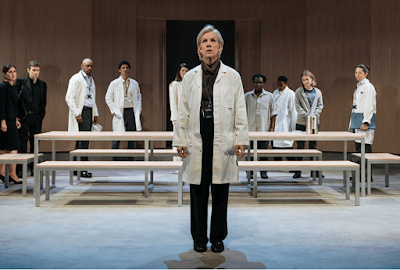
Olivier Award-winner Juliet Stevenson stars as the doctor at the center of the drama where nothing is quite what—or who—it seems. A galvanizing piece of theater, the production serves as a stark health warning for an increasingly divided nation, where clashing views about the way we see ourselves and the world we live in today only magnify the complexities of life.
Cast & Creatives
Very Freely Adapted from Arthur Schnitzler’s Professor Bernhardi
Adaptation and Direction Robert Icke
Set and Costume Design Hildegard Bechtler
Lighting Design Natasha Chivers
Sound Design and Composition Tom Gibbons
Casting by Julia Horan CDG
Additional Casting by Jim Carnahan
Community Discussion


A great piece of theatre always reflects the time when it was born, and "The Doctor," first staged at London's Almeida Theatre in 2019, has become the play for post-pandemic America. "Freely adopted" from Arthur Schnitzler's 1912 play "Professor Bernhardi," British playwright and director of this production Robert Icke takes Schnitzler’s central dramatic conflict about a doctor refuses a Catholic priest to perform the last rites on a girl dying from sepsis due to a botched abortion and greatly expands on it. Here, the doctor is Ruth Wolff, played by English stage treasure Juliet Stevenson, Wolff is the chair of the Alzheimer research department at a top-tier private hospital she helped founded. Her angular face is imprinted on the show's poster, declaring a feminist identity while showcasing a protective androgyny. Stevenson's Wolff is described by her collogues as "a woman in name only," a common situation female leaders in top fields have found themselves in, presumably for all they did to get to the top. She has no tolerance for any stupidity in her life, correcting grammar and addressing her colleagues with absolute authority, if the setting were the early 2000s and Wolff were male with a limp and a drug problem, an English actor could have turned the role into a long-running TV show. But times have changed. When a Catholic priest shows up at the hospital, like in a Greek tragedy, Wolff's inevitable downfall starts to unravel before our eyes. Icke makes the fall long and compelling. Wolff's rejection to the priest is based on medical grounds. But a small push, deliberately stylized to make the audience uncertain of its severity, as well as the push of a recording button make everything take on a grander scale. The incident soon becomes a national debate, and Wolff's own identity as a Jewish woman becomes an uncomfortable focal point within her collegues. This is in line with Schnitzler's Bernhardi, referred to in the play as "Vienna's Dreyfus." Bernhardi's insistence on his Jewish identity having nothing to do with his decision to refuse a Catholic priest falls on deaf ears, especially when the toxic air of anti-Semitism is reeking through Viennese society at the turn of the century. One hundred and ten years later, those toxins are seeping back. In the original play, Vienna was a "Christian State," and as history showed, Jews would soon not be welcome there (Another fantastic transfer from London this season, "Leopoldstadt" by Tom Stoppard, even tries to invite Schnitzler to a party in the first act). While UK may have a more robust public health system and a separation between the crown and government, here in America, the motto "In God We Trust" is still printed on the currency. Watching the first act of this play after a long exhausting pandemic feels like reliving those Fauci vs. Trump press conferences in early March 2020 when science vs. non-science became elitism vs. the masses. But Icke understands the complexity of modern identity politics and how people use it to their advantage. Every single character in this play, except Ruth, were casted not directly in term of their identity. Thus our presumptions and sympathies to these characters are constantly switching as we learn more about them through conversation rather than first impression, much like the discourse on the internet, where you hear people declare their indefinity rather than see them. If the first act feels like reliving Covid Part I, then the second act is the part where the entire nation needs to readdress its unconscious biases. Instead of focusing on a medical tribunal to examine Bernhardi's medical license, Icke throws Wolff (her own decision in the play) into the court of public opinion in the form of a TV program called "Face the Debate." In an attempt to cast the audience in her position, Stevenson's face is also captured in extreme close-up. She is less confident here, with more facial contortions registered than the physical and linguistic briskness of the first half. Maybe it's because, by taking off the symbolic white robe, Wolff loses the one identity she clings to more than anything, that of a doctor. Now under scrutiny from five panelists with different viewpoints and expertise, Wolff's perception of herself quickly unravels until the use or misuse of one word ruins her confrontation with the priest, highlighted in the recording. Our understanding of Ruth and of ourselves is questioned over and over, just like the long, heated summer of 2020. What Icke has created is a prism of theatrical experience; what you bring into it reflects differently by the end. But everyone is entitled to a truly thrilling theatrical experience led by Stevenson and the fantastic cast of British actors. Daniel Rabin and Naomi Wirthner bring out the best as antagonist doctors against Wolff, while Doña Croll and Chris Osikanlu Colquhoun are her ardent supporters, both arguing with fantastic flair. John Macaky's father is intense in every way, while Jamie Schwarz's junior doctor is observant and discreet in using her power. Icke fills out Wolff's personal life with Malinda Tucker's Sami and Julit Garricks' Charlie, both excellent in their vaguely defined roles. Stevenson's performance as a Greek tragic hero in the modern age is more than fantastic; it's once in a lifetime. Such a part and such a play just don't come around all that often.

The Doctor came highly recommended to me from friends who had seen the original West End production. I was unaware whether the praise came from spectacle or story, but decided to go in completely blind. That was a great decision, for this show reveals itself slowly over the course of three hours, unmasking its own secrets and pointing out your expectations before twisting them. This was the first discussion I’ve seen on cancel culture that felt like an exploration rather than a sermon. With a topic as new as it is nuanced, the Doctor told a story that is very timely while also feeling large enough to become timeless. There’s no political discussion left off the table, but no definitive side taken. I confronted multiple opposing views and contradictions within my own opinions, finding my alliances among different members of the stellar cast. The back drop which first appeared bare transformed in magical ways and blasted through the limits of technical achievement. The greatest achievement was Juliet Stevenson, the titular doctor whose undoing the story follows and who fluctuates in a limbo of hero to villain as the events of the first act are retold and reexamined. Her performance was undeniably captivating. For such a long show, there were only a few moments of lag in the final act. There was always a rich conversation or entertaining set change to keep the audience engaged. I found the ending unsatisfying, although I do believe that was the intention of the playwright/director Robert Icke. There was no neat bow to be tied on a show like this because there’s no consensus to be reached on cancel culture and political disagreements. I highly recommend The Doctor for a night of stunning theater that will leave you thinking.
‘The Doctor’ is one of the next great plays. Director/writer Robert Icke has adapted the 1912 play ‘Professor Berhanhardi’ into a suspenseful contemporary drama that explodes identity politics through a debate of science versus religion. Let me be clear: this is a must see. I saw ‘The Doctor’ in its premiere production at London’s Almeida Theatre in 2019 and anxiously awaited news of an American transfer. The Park Avenue Armory is a perfect venue for this play, providing an expensive space that’s been built into a conference room at a leading British Alzheimer’s institute. A slow-moving turntable and single percussionist enhance the ticking time bomb that is this play. Through Icke’s unconventional casting device, ‘The Doctor’ forces you to re-examine implicit bias. How does the appearance of one’s identity influence the way an audience perceives them? How important is one’s identity when we witness their actions? Icke refuses to provide any concrete answers, but his dialogue offers a playground of endless thought. Juliet Stevenson as Dr. Ruth Wolff delivers an astonishing performance. I cannot begin to fathom how Stevenson musters up this stamina for eight three-hour shows each week. It’s extraordinary. ‘The Doctor’ has a long life ahead, so I’d recommend running to the Armory as soon as possible. When it’s studied in Play Analysis courses and used for audition sides, you’ll get to say “yeah I saw the original Off-Broadway run years ago!”