
About
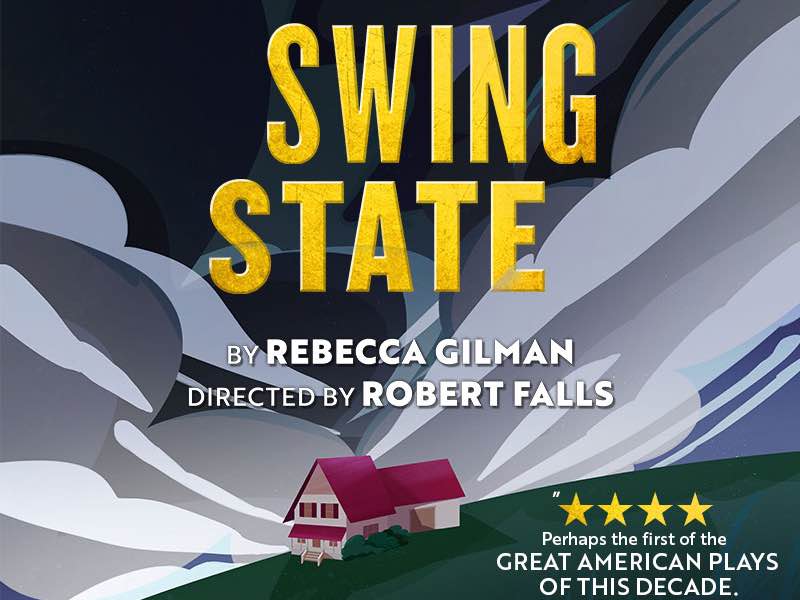
Evenings on the prairie are relatively quiet for Peg, a recently widowed woman in rural Wisconsin who still cooks for two. Which doesn’t go to waste whenever Ryan, a dear friend with a troubled past, pays her a visit. However, after noticing her husband’s toolbox is missing, she places a call to the local authorities—unwittingly setting off a series of events that will forever reverberate through the small community. Direct from a hit run at Chicago's Goodman Theatre comes this complex, humanistic yarn written by Pulitzer Prize finalist Rebecca Gilman and directed by Tony Award® winner Robert Falls. Get tickets now to what the Chicago Sun-Times calls "an engrossing work of intense melancholy, filled with sympathy for its characters, and for the country."
Cast & Creatives
Written by Rebecca Gilman Directed by Robert Falls
Community Discussion


After receiving critical acclaim at Chicago’s Goodman Theatre, Rebecca Gilman’s ‘Swing State’ has arrived in New York. The play opened downtown Sunday night at Audible’s Minetta Lane Theatre. Instead of the political drama that its name may suggest, ‘Swing State’ questions if we’re leaving the world and its people better than how we found them - though politics are certainly included in this mission. The liberal environmentalist Peg (Mary Beth Fisher) is a recent widow who lives on 50 acres of prairie in rural Wisconsin. She acts as a mother figure to Ryan (Bubba Weiler), a young neighbor with a troubled past. As a lover of kitchen sink family dramas, I can appreciate stark realism with little spectacle. But ‘Swing State’ lacks a sense of creativity in form. Director Robert Falls’ devotion to hyper-naturalism and Gilman’s exposition-heavy dialogue leaves little room for the imagination. Falls’ blocking confines the characters to sitting at the kitchen table or standing around a counter (the delicious, fully functioning set is designed by Todd Rosenthal) where they explain histories before the audience has a moment to think for themselves. We simply watch and listen - never quite tasked to wonder. With a runtime of one hour and 45 minutes, I longed to feel a connection to these characters. While Peg and Ryan are well realized characters (whose actors deliver solid performances), the stiff dramatic structure kept me at arms-length. Don’t get me wrong, the play offers plenty of substance through its discussions of suicide, policing, climate change, incarceration, and addiction. But even the dramatic climax, though staged with a tragic intensity, doesn’t help the pendulum of this “state” swing.

Except lead guy!
Knowing only the title, “Swing State,” as I walked into the Minetta Lane Theatre for a matinee, I expected political parody, Trump commentary, and perhaps something along the lines of the 2008 Kevin Costner movie of a similar name. What I got was something completely opposite of parody, with Trump only being name-dropped once, and the major election discussion being one of a small town Wisconsin sheriff. The political title could be traced to a metaphor about the lives of Americans in the divisive times of 2021, the friction of national issues at the local level, but it’s never explicitly linked. What’s left in this incomplete theme is a human story that soars when it stays within the interpersonal connections and flops when it preaches outside their world. This show, and subsequently this review, needs a trigger warning for discussion of suicide. Peg, our protagonist played by Mary Beth Fisher, begins the show making zucchini bread, quickly turning the knife on herself as she contemplates self harm. Thankfully, she’s interrupted by Ryan (Bubba Weiler), her neighbor and sole friend after her husband passed away last year. Peg and Ryan have a beautiful, maternal relationship, spending the show musing over nature, grief, and addiction. Ryan is sober after a previous arrest where he spent three years in jail and Peg is trying to keep him on the straight and narrow. Ryan tries to keep Peg safe from her grief, but when a vintage gun she owns goes missing, Sheriff Kris (Kristen Fitzgerald) and Deputy Dani (Anne E. Thompson) immediately accuse Ryan. Peg Smith, although with a very generic name, is a far from generic character. Fisher runs the gauntlet of emotions, coloring every moment with an honest rollercoaster of grief. She is constantly unexpected, breaking into tears while describing grass and then regaining her composure sentences later. Her relationship with Ryan is the grounding force of the story and the tethering motivation in her planning of suicide, organizing to leave him the prairie and her house. Bubba Weiler gives a great performance as well, unhinged in his own grief and addiction, but ultimately always working for the protection of Peg. They were very heart warming as a unit and brought a few tears to my eyes as they tried to help each other. I was locked in with their love for one another, though the biggest moments of dragging came from the discussion of the land. Peg is very protective over preserving her prairie, and even as Ryan makes fun of her lamenting over extinct bats and invasive runoff, he tries to stick with her. Forcing the audience to also bear with this talk does lead it to stall the pace. It felt like an attempt at a call to action without any succinct motivation. As a slice of life play, the show worked for me. The discussion of injustice within the animal kingdom and prison system wasn’t completely effective but not fruitless. I found myself deeply caring for Peg and Ryan’s relationship, even if I can’t recall all the plant types she discussed trying to save on her land. Playwright Rebecca Gilman, a resident of rural Wisconsin with personal inspiration for the show’s set, didn’t leave me with any new takes on vaccinations or nature preservation, but I will be continuing to think about her musings on grief and the people we turn to after someone is gone.