
About
In the spring of 1983, in a groundbreaking act of cross-cultural collaboration, Arthur Miller accepted an invitation to direct his play Death of a Salesman with an all-Chinese cast at the Beijing People’s Art Theatre despite not speaking a word of Mandarin. The production was a resounding success due, in no small part, to the multilingual talents of renowned Chinese actor Ying Ruocheng (Bertolucci's The Last Emperor) who translated the text and played Willy Loman.
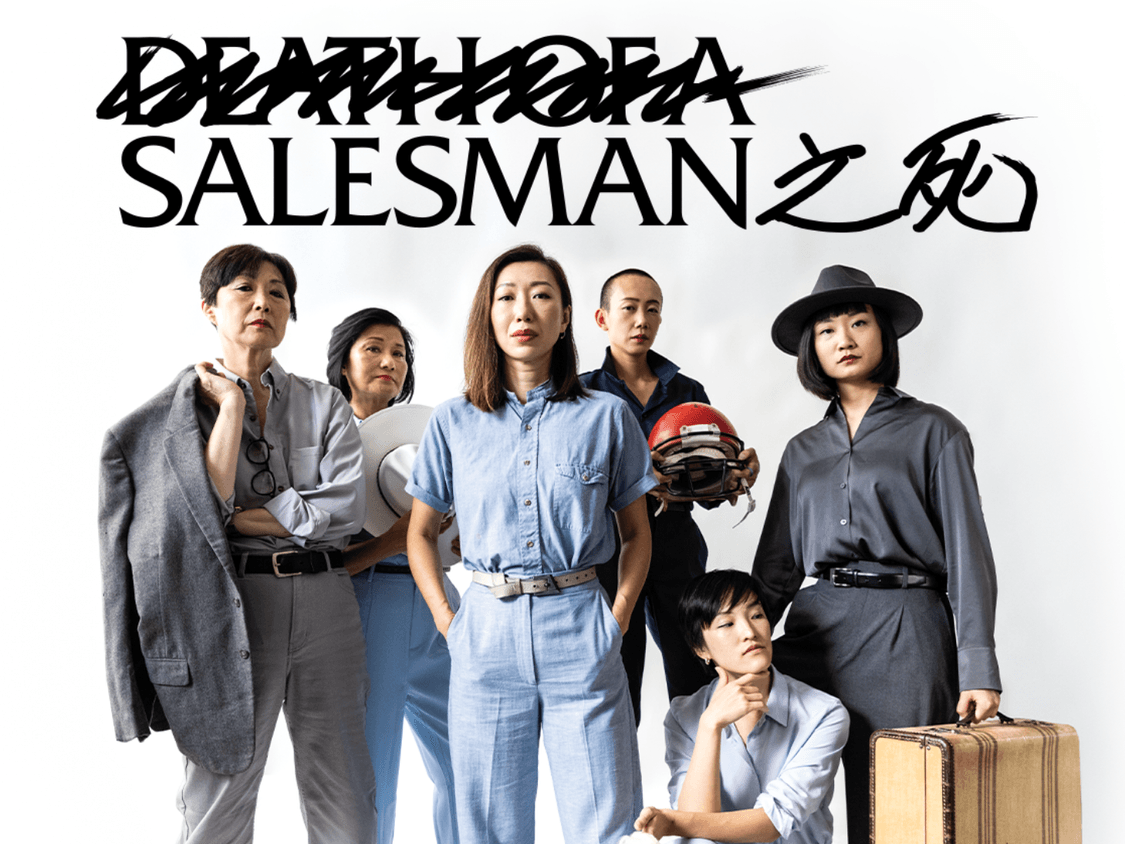
This extraordinary encounter, which Miller detailed in his memoir Salesman in Beijing, is the inspiration for Salesman之死, which centers on Shen Huihui, a young university professor, who is summoned to the theater for a special task: to interpret for Arthur Miller, who will soon arrive to direct his iconic play – in Mandarin. Meanwhile, the Chinese ensemble, newly out of the Cultural Revolution, has never met “a salesman.” Will they be able to find common ground? Mostly based on true events, Salesman之死 is a multilingual tale of cultural confusion, impossible translation, and unexpected encounters amid the chaos of theater making.
Cast & Creatives
Written by Jeremy Tiang Directed and Developed by Michael Leibenluft
Community Discussion

Arthur Miller’s “Death of a Salesman” premiered in 1949, when America was still recovering from the wounds of winning the great war. Unlike its protagonist, the country went on to enjoy great prosperity, partly due to its competition with the Soviet Union. Miller’s status as a first-rate American dramatist and a conscience of the nation fell greatly in the following decades. His depression era multifamily epic “American Clock” played for only 12 performances before it closed on Broadway in 1980. Soon, in 1983, he found himself as a director of his own words in the recently “opened and reformed” China. Singapore-born playwright and translator Jeremy Tiang took on the momentous task of capturing this cultural clash, lighting in a bottle moment. Miller was invited to Beijing People’s Art Theatre by Ying Ruochen, a famous actor, educator, and translator and the vice minister of the Department of Culture from 1983-1990. Extremely skilled in both Mandarin and English, Tiang adapted a fly-on-the-wall approach, making translation the heart of the production. Produced studiously by Yangtze Rep, the Connelly Theater in the Lower East Side was transformed into the Capital Theater, the home turf for People’s Art Theatre since 1956. The green curtains and red banners, along with the chalkboards on the two sides carefully curated by set designer Chika Shimizu, captured the strange spirit of a bygone Beijing. (the dusty smell of Connelly certainly helps too) Instead of Ying, who translated the play to Chinese and would be playing Willy Loman in the Chinese premiere of Salesman and Miller, who was directing in a foreign land without speaking a single word of Chinese, the playwright chose the translator Shen Hui Hui as the protagonist, with a rather straightforward narrative of a rehearsal room drama. A young English professor from the prestigious Peking University, Shen had written her thesis on Miller’s work and miraculously received excellent English education throughout the decade-long Cultural Revolution (1966-76). Her simple answer of “I was lucky” had more complexities embedded to a Chinese ear. At the top of the show, Jo Mei as Shen promised the performance would be in two languages and contain “multiculturalism, meta-theatrical elements, and Communist ideas.” Unfortunately, not all these promises were kept. Jo Mei’s excellent, if not a bit stiff during the Chinese parts, translator, is supported by an ensemble of female-presenting East Asian artists. Each of them had to double up on some roles; still, Julia Gu and Lydia Li’s excellent Chinese make them the standouts among the rest of the cast. After all, Beijing People’s Art Theatre even until today still generally adopts a Beijing accent which is different from standard Mandarin. Li’s interpretation of Ying and Gu’s tech worker master Huang really benefited from their comfortability with Chinese, especially Gu, who also brought detailed tone and physicality changes into her meticulous acting. Sandia Ang and Claire Hsu also had to do a lot of Chinese acting, but their strongest moments came from miming to a recorded audio of a historical performance of Cao Yu’s “Thunderstorm,” where they captured the Peking opera relic left in stylistic acting choices. But People’s Art Theatre didn’t only inherit the traditional; from their name, it is clear they also molded themselves after Stanislavsky’s Moscow Art Theatre and strive for both realistic acting as well as communist values when they established in 1952. But 30 years later, it opened its arms to fully embrace capitalism and the ex-husband of Marilyn Monroe. If you were to survey Chinese people about their favorite Western leaders from the 20th century, the top two names are definitely Richard Nixon and Margaret Thatcher. Dicky for his effort of reaching out to China under the advice of Henry Kissinger. (still referred to as “a good old friend of the Chinese people” by CCP) And the Iron Lady for her role in returning Hong Kong to the mainland. Both for their diplomatic efforts, since no Chinese have to endure their domestic policies and embarrassments. Commenting on the politics and historical background of any foreign country without coming across as condescending is difficult, and the creators of this production are highly aware of that, so they opted to stay in the safety zone. The plot is simply Miller arriving in Beijing, rehearsing the play, and then it opens. Despite the huge amount of Mandarin used in the production, little historical context is given out to the audiences (The subtitle machine is swiftly operated by Xingying Peng on stage, but the middle one is overshadowed by light design). Every time the Cultural Revolution is brought up, there is a general hush among the rehearsal room as if the creators are telling the audiences to look it up later if they don’t know. A fascinating scene of about “The Crucible”where a play about prosecuting alleged Communists widely read by people who were recently prosecuted under the guise of Communisms, but trading a careful line it only dwelled on the language level. Without knowing what came before or after this production of Salesman, the play consists of short scenes of cultural misunderstandings. Some punctuated by a self-deprecating from a materially privileged position American humor, like the absolute need for cars and the size of fridges. Others are scenes ended on vaguely oriental wisdom you can buy as a fridge magnet, like “perhaps they look harder” or “They ran out of plates, just don’t know it yet.” The short scenes are punctuated by the knocking of a wooden fish commonly used by Buddhist monks during praying sessions, which helps the show move along quickly but doesn’t demystify those vaguely Zen-like wisdoms. Director Michael Leibenluft pushes this bilingualism to a high tempo that quick changes are often too rapid for the costumes to catch on; still, speed is needed here to give the audiences a whirlwind experience of cultural clashes. Playing Arthur Miller, Sonnie Brown is the only actor who doesn’t have to speak Chinese all night, and she brings a very grounded performance to the part that also helps to anchor the production. But the whole female-presenting casting choice clearly has some sort of artistic statement that’s a bit muddled for me. Is it a revolt against the Peking opera tradition that no women were allowed on stage or a doubling down on the patriarchal Oriental gaze that always feminizes Chinese culture? It’s a marvelous effort to capture a moment of cultural exchange but fails to make any point through the night. 1983’s Beijing was different from now, and the relationship between America and China has also drastically changed during the last 40 years. The production ended with a recording of the real-life Shen, who resides in Canada now. Her statements of she was the “chosen one,” coupled with real-life footage of Chang An Street right in front of Tiananmen Square, which would be covered by sweat and blood from students 6 years later from 1983, create a strange dichotomy. Individualism vs. collectivism, capitalism vs. communism, home vs. away are all muddled together; maybe the stickiness is the true byproduct of any cultural clash, the very definition of translation, or maybe in the end of days, we can only be responsible for ourselves as human individual and our own narrative, nothing more, nothing less."