

About
In Rheology, Shayok Misha Chowdhury joins forces with his physicist mother, Bulbul Chakraborty. Bulbul is obsessed with the mystery of sand: how it flows like a liquid, but then jams into a solid. Misha is obsessed with his mother. But they’re running out of time. In this boundary-pushing collaboration, an artist son and his scientist mother challenge each other to a high-stakes experiment.
Cast & Creatives
Written and Directed by Shayok Misha Chowdhury In collaboration with Bulbul Chakraborty
Seat Views
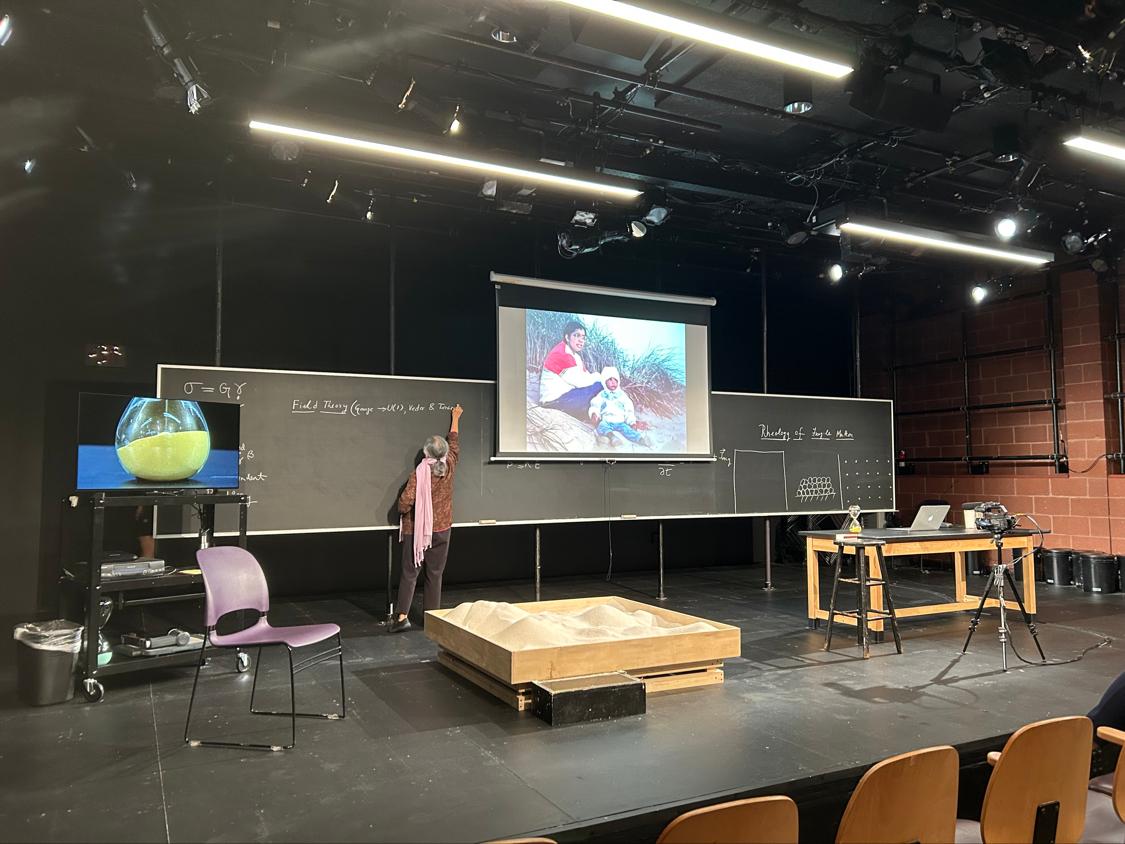
View all 2 seat views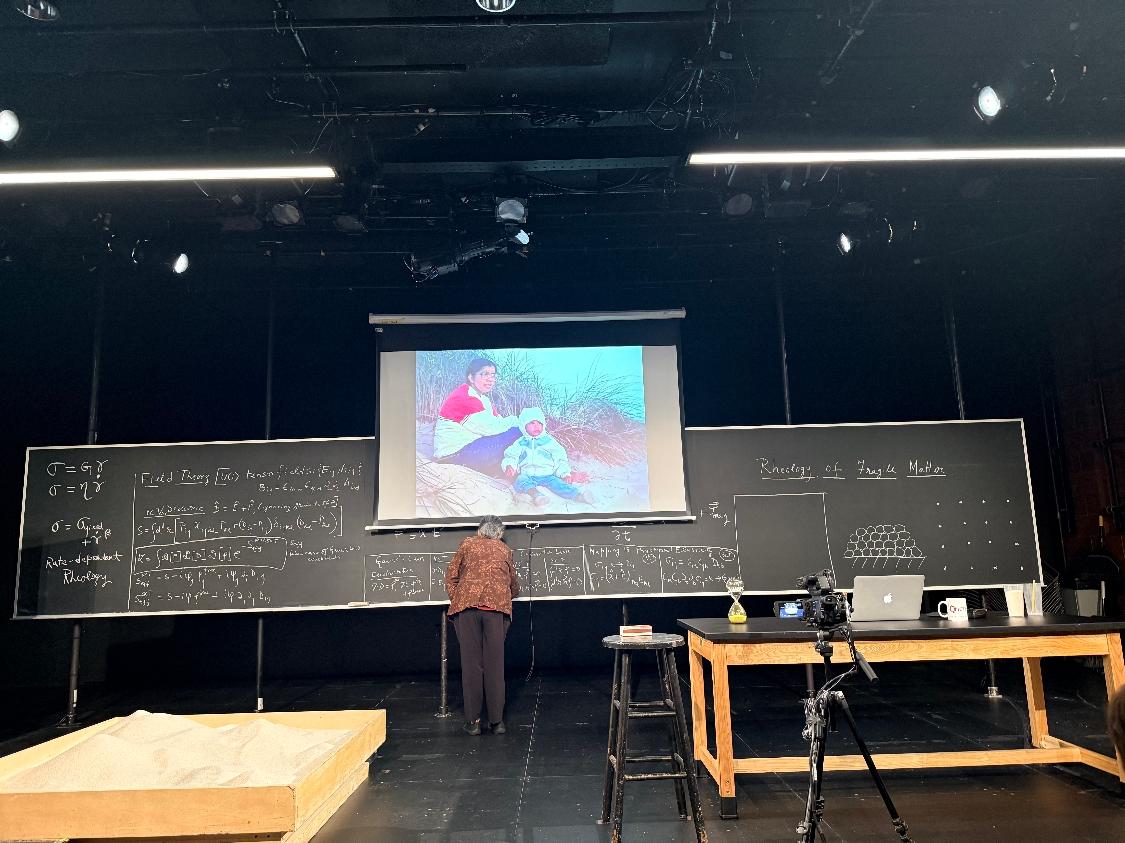
Community Discussion


 Recommend it
Rheology is one of the most beautiful plays I have ever seen, weird and wonderful as it oscillates between the joy of connection and the pain of loss. Bulbul Chakraborty is an incredible actor precisely because she doesn’t see herself as an actor. She and her son, director/playwright/actor Shayok Misha Showdhury, are smart to open the show with a physics lecture from Chakraborty that shows us just how warm, funny, and alive the mother is before we deconstruct and collectively feel the tragedy of her impending death. Her physicist esoteria is so beautifully concrete, and Showdhury’s theatremaker lingo is so meandering. He’s the one who will lose her, after all, and he’s had significantly less time than she has to come to terms with her mortality. As the theorist, Chakraborty gives us concrete data; as the experimentalist, Showdhury shows us every angle he can think of to disrupt that data. The play’s exploration of just where a mother ends and her son begins allows for the most gorgeous of onstage revelations about grief, life, death, and where we go when we’re not here anymore.
 first row
 Recommend it
This is the best play I’ve seen so far this year—and I won’t reveal anything about it. Every fraction of this play is a surprise, and all those surprises come together to form something deeply cohesive and complete. Unwavering facts, physical laws dissolve seamlessly into emotion: fear, loneliness, balance, transition and a profound sense of inclusiveness. To me it feels like a reflection of Southeast Asia culture as a whole—an exploration of both the physical world and the inner landscape of the mind. But you do need to be slightly interested in physics to enjoy this show. Slightly will do.
Row A Recommend it
“Rheology” by Shayok Misha Chowdhury plays at Playwright Horizons until May 16th. The show follows a mother and a son as they grapple with the intersection of physics and experimental theater as a method to confront morality. The show is surprising and haunting, yet so human. Frankly, I don’t know how to talk about the show without revealing its twists. As soon as I thought I knew where the show was headed, it would take a left turn. If I could give one piece of advice, it would be to see this show without knowing anything more. Well, I would advise theatergoers to avoid the first three rows as it can make some dialogue difficult to see. I apologize for the short review, but all I can say is that you should see it and experience it for yourself. This will likely be one of my top ten shows I’ll see this year—I have little doubt about that.
A16 Recommend it
An intimate, clever, interesting, experimental play that feels wholly original. By mixing science with theatre, the evening feels both academic and spontaneous — like watching a science experiment. It’s funny and disarming, but also touching and emotional. And kudos to the design team, who created some mind-boggling effects. (Edited)
C10
Rheology follows the intimate story of Chayok Misha Chowdhury and his physicist mother, Bulbul Chakraborty, as they take an existential look into their past, their current relationship, and Chowdhury’s coming to terms with the future death of his mother. This show challenged me in a way I hadn’t been in a long time. As someone who doesn’t watch a lot of experimental theater and a person who has lost a parent, something resonated with me even during very challenging aspects of the play. It utilizes our discomfort with death and puts it right in our face. Sometimes it takes you through the wringer, but I truly felt a sense of catharsis at the end, especially connecting death to the physical world and the physical properties of sand. My favorite part was easily Chakraborty’s performance. Despite not being a trained actress, she is radically empathetic and has a genuine desire to connect with you, like any good educator should. And the fact that she is doing this play with her son 4 nights a week shows how much she cares for him and vice versa. The use of sound, particularly with a live cellist, was used both to punctuate the play’s morbid humor and genuinely bring you into the story. You were very aware of its presence in the room yet were completely immersed when it was used in serious moments. Chowdhury does have an incredible gasp on his audience’s emotions and took us on the exact journey he wanted. This play is not for everyone. Several people walked out of the theater, and towards the beginning I was considering it as well. Some aspects were very close to crossing a line into manipulation, especially a moment at the beginning where [spoiler but I feel it’s important] Chakraborty pretends to choke. This felt like it was more for shock value than to drive home a point, and I feel it could have been executed more cleanly in a way that tied into the greater story. Additionally, some elements of the greater metaphor fell flat or like a bit of a stretch to me. There is a running theme of the properties of sand throughout the show that relate to death and grief, but I don’t feel that it was utilized to the greatest extent it could have. That being said, I still understood the greater messaging, and it comes together in a beautiful monologue about how grief shapes us. Biggest complaint: I genuinely wanted to learn more about sand. Chakraborty is too compelling of a lecturer to have her explanation end in the middle. I applaud both Chowdhury and Chakraborty for this undertaking, especially the latter for being brave enough to enter a world that is more foreign to her. Even though this play is very challenging, I am excited to see where it takes them both.