
About
PYGMALION. George Bernard Shaw’s most famous and beloved play is the basis for the musical My Fair Lady. It’s a rollicking comedy that reminds us of the importance of being as fully connected to both our head and heart as we can, and to live our life as fully as possible. A celebrated professor of phonetics makes a wager that he can pass a bedraggled Cockney flower girl off as a duchess at an ambassador’s garden party by giving her the tools of education. But, before the lessons are over, she has become his teacher, as well: helping him learn to face his emotional self as an aware human. The play is a sharp lampoon of the rigid British class system of the day and a commentary on women’s independence.
Cast & Creatives
Directed by David Staller By George Bernard Shaw
Community Discussion

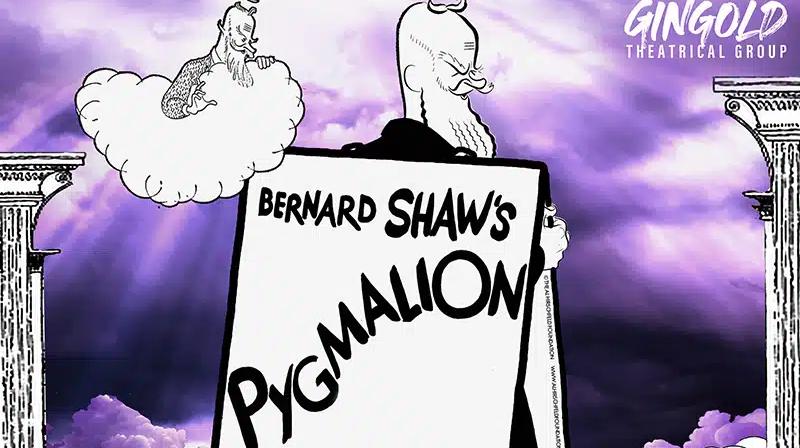
If you’ve ever thought Pygmalion was dusty, academic, or only useful for explaining where My Fair Lady came from, Gingold Theatrical Group would like a quiet word with you. Or rather, a noisy, playful, very self-aware conversation involving gods, mortals, accents, and more costume changes than I managed the entire month of October. David Staller’s production doesn’t tiptoe around Shaw’s mythic inspirations, it kicks the door open by literally dropping four gods into the room. These divine troublemakers (played with great glee by Carson Elrod, Teresa Avia Lim, Lizan Mitchell, and Matt Wolpe) basically say, “Alright, mortals, let’s run this experiment again,” and then proceed to role-swap their way through the story like a group of theater kids let loose with a trunk of wigs. It works. Against all logic, it really works. Synnøve Karlsen’s Eliza is not some chirping stereotype; she’s grounded, sharp, and already halfway to transformation before Higgins even gets a word in. Mark Evans’s Henry Higgins, meanwhile, has perfected the exact level of pompous brilliance that makes you want to shake him and applaud him in the same breath. And Carson Elrod’s Pickering? Let’s just say he brings the kind of supportive-uncle energy every chaotic linguistics project deserves. Matt Wolpe deserves a special award for playing both Freddy and Alfred Doolittle with such wildly different shades of charm, and two very different British dialects, that I had to double-check the program just to be sure I wasn’t hallucinating. But let’s talk about that design: Lindsay Genevieve Fuori’s set looks like someone whispered “What if Al Hirschfeld sketched a dream you could walk around in?” and then actually built it. It’s whimsical without being precious, and the clean lines give the whole production a crisp, cartoonish lift that makes the play’s wit hit even harder. Tracy Christensen’s costumes play along beautifully, and Jamie Roderick’s lighting shifts us between the god-world and the human-world with the flick of a well-calibrated metaphorical switch. The whole evening has the cheeky confidence of a production that trusts its audience to keep up—and the bonus is that it’s genuinely fun to do so. The play still asks its big questions about class, transformation, power, and who gets to define “proper” speech, but it never feels like homework. It feels like theater, the lively, imaginative kind that makes you grin at intermission. If you’re expecting songs and ball gowns and dancing chimney sweeps, you’re in the wrong building. But if you want a Shaw that feels alive, a cast that looks like they’re having a ridiculously good time, and a production that actually leans into the mythical framework Shaw intended, this is the one to catch. Run, don’t stroll. It closes November 22nd at Theatre Row, and it’s far too delightful to miss.