
About
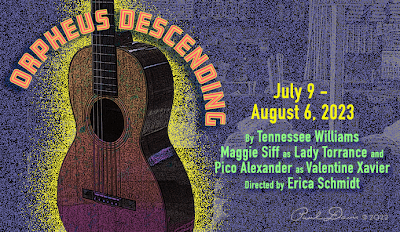
Tennessee Williams’ Orpheus Descending tells the story of the passion of two outcasts—Lady Torrance, a storekeeper’s wife and daughter of a murdered Sicilian bootlegger and Val, a wandering guitar player—and their attempt to escape from a Southern Hell.
Set in a small town dry-goods store in the Deep South, Orpheus Descending is a toxic brew of racist violence, bigotry, misogyny, sexual passion and longing for liberation.
Maggie Siff (Billions, Mad Men and Sons of Anarchy) plays Lady Torrance and Pico Alexander (Catch 22, Simon Stephens’ Punk Rock and A.R. Gurney’s What I Did Last Summer) is Valentine Xavier.
Erica Schmidt, who adapted and directed Shakespeare’s Macbeth for seven schoolgirls entitled Mac Beth (“raucously exuberant”) and this season’s Lucy which she wrote and directed (“seamlessly layered, extraordinarily entertaining and …cleverly detailed”), stages, in her TFANA debut, this seldom-seen Williams masterpiece.
Cast & Creatives
Featuring Pico Alexander
Amy Rubin
Jennifer Moeller
David Weiner
Justin Ellington
Cookie Jordan
Andrew Wade
John Lahr
Lorenzo Pisoni
Justin Cox
Shane Schnetzler
Xavier Clark
Community Discussion


Orpheus Descending is a Tennessee Williams play that seldom sees a production. I now know why. Various small-minded characters in a small southern town gather in a general store, sharing their problems with Lady, its proprietor. When Val, a young rebel, enters the store looking for work, he kickstarts a dynamic with Lady that loosely draws from the Orpheus myth. I applaud theaters for unearthing hidden gems by legendary playwrights, like BAM did with Lorraine Hansberry’s The Sign in Sydney Brustein’s Window. Theater For a New Audience probably should’ve let this one stay buried. I was surprised to that Williams wrote Orpheus Descending years after A Streetcar Named Desire, since it feels like a rough draft for his most lauded work. It has a proto-Blanche and a proto-Stanley, whose circumstances don’t hold a candle to their counterparts (this play’s Stanley is quite sickly, making one wonder how he can dominate others when a cold breeze would likely send him to Hades). Rarely performed plays don’t open doors to bold interpretations. Eric Schmidt, who directed an imaginative take on Macbeth, oversees a by-the-book production. It only highlights its age. When men catch Val putting his hand on a married woman’s shoulder (gasp!), they rough him up. In the ensuing fight, one man rips Val’s shirt off, which prompted a holler from a younger audience member, followed by giggles. Can you imagine politicians getting angry about a man touching a woman’s shoulder? I’m sure Pepperidge Farm remembers, but it comes off as quaint. Creative casting or choreography could’ve made this work relevant to today’s issues. Though perhaps it’s unfair to continuously compare the play to Streetcar, it did have me wishing I was watching the iconic play instead. Still, it has its moments, named in scenes just between Val and Lady, when they share their notions of freedom. Pico Alexander and Maggie Siff certainly help with their emotional and engaging performances. In fact, the whole cast adds much to the other more thinly drawn characters. Various accents tend to geographically wander, but they lean into the clever wit of Williams’s dialogue. The plot is shaky, but the playwright’s command of voice remains strong. As such, if you’re a fan of Tennessee Williams, you may wish to see a work of his that’s rarely done. And yet, there is a certain irony of Theater For a New Audience unearthing this relic from the past. Orpheus Rising tiptoes around ideas of race, class, and gender, but a new audience deserves new plays that tackle these issues head-on.
Although I have read plays like “A Streetcar Named Desire,” I have never seen a Tennessee Williams play performed, and “Orpheus Descending” did not disappoint. A tragic story of a closed-minded small town in the 1950s South, “Orpheus Descending” begins when a handsome young stranger appears in a general store and asks for a job. The store is owned by a very ill old man and his much younger wife, and is frequented by nosy townsfolk, including the town harlot. The play is sizzling with tension and romantic chemistry, as the young wife and handsome stranger begin an ill-fated affair. I worried the text would feel in-accessible due to its age, but it was easy-to-follow and truly riveting as you can feel the small town closing in on the lovers. My only real complaint was somewhat confusing directorial choices. The set included a one room house with a hidden upstairs, but actors often moved out into black stage space beyond the house that didn’t have any real sense of place. The lighting was meant to emphasize key lines, but spotlighting characters for short monologues broke the flow of the story. This is not a happy play, but it is a powerful one about how close-mindedness and distrust of anyone different squashes hope for new beginnings. I highly recommend it.