
About
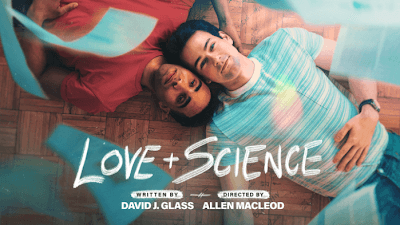
Set in the 1980s in New York City, gay medical students Matt and Jeff connect while working in a retro-virology lab. When HIV erupts, the fallout upends their relationship as their response to the rising epidemic pushes them along different paths, raising questions about their values as scientists and doctors and their responsibilities as gay men. A sprawling drama spanning the decade, Love + Science explores the difficulties of love during a crisis, the realities of scientific progress, and how to maintain hope in the midst of an epic struggle.
Cast & Creatives
Director: Allen MacLeod
Written by David J. Glass
Community Discussion


Love+Science In David J. Glass's new play, "Love + Science," we are taken back to the 80s when New York City was a seedier place but less lethal or hospitable for the gay community. Matt (an affable Matt Walker) and Jeff (charming Jonathan Burke) meet each other on the first day of their medical school journey, and the two immediately fall for each other. They go out, have drinks, talk about science, and have sex. Everything seems to be going well until the HIV epidemic makes its entrance. The scientific discourse in this play is not bad at all. We start with a discriminating lecture and transition to some lab talk that tries its hardest to pass as dramatic dialogue. We also explore some of the key historical moments in the early days of the epidemic, from Act Up to the approval of AZT and then the cocktail treatment. It is clear that Matt's research as a scientist has helped in finding a cure for this horrible disease. However, the love aspect seems to be more elusive. Although Jeff says he is in love with Matt, the majority of the play focuses on how Matt is terrified of the disease and the various forms of self-loathing it leads to. There is no sense of urgency like in "The Normal Heart" nor the universality of "Angels in America." Aside from the two leads, there are some touching performances from Ryan Knowles, who plays a dying old friend of Matt, and Imani Pearl Williams in multiple shape-shifting roles. But what promised as a two-pronged play ends up incredibly lopsided, resulting in an ending that feels oddly positioned in 2022, where being politically involved for a cause and finding a cure for a disease are pitted against each other. With almost every scene overstaying its welcome (Allen McLeod directs some incredibly drawn-out transition moments), the play serves as a good reminder of HIV and other epidemics we are living through, but I doubt any of its characters will stick around.
‘Love + Science’ was a little more science than love, but for me, it worked. When we look at plays about HIV/AIDS, someone is dying or a relationship is destroyed. They are often quite tragic (and justifiably so). Instead, ‘Love + Science’ places its emphasis on the virology behind H.I.V. and the early data that foreshadowed an epidemic. Does all this science jargon come at the expense of nuanced, well-developed character relationships? A bit. David J. Glass’ dialogue keeps our characters on the surface. ‘Love + Science’ offers solid performances, especially from real-life scientist/actor hybrid Matt Walker (Matt). Matt (the character) displays an obsession with retroviruses that fuels his panic over potential consequences of his past and vice versa. With incredible advancements in modern medicine, it’s easy to scoff at a young man afraid to kiss another in the early 1980s. But it’s the same way we washed groceries during the Covid-19 pandemic or let our mail marinate outside for a couple days. Uncertainty causes a change in our behavior. While I desired more artistry from this production, I’m happy to have seen ‘Love + Science’ before its closing on July 6th.