
About
Records of Alan Mathison Turing, of his mathematical-ingenious brain, and of the historical facts that are formed around him are surprising, interesting, and full of theoretical speculation about the impact that research into athletically built genius has had and still has on the development of artificial intelligence. We can read about his research work, which was crucial to solving the Enigma (a German electric message encryption device used during World War II), about his scientific work at the University of Manchester, about his more than just friend Christopher Morcom, who died prematurely as a result of raw milk poisoning and about his tragic fate.
He was forced to choose between ways to deprive him of his precious freedom in the midst of then-hostile society. He was succumbed to chemical castration, which led him to physical and mental modifications, to the impossibility of physical and mental speed, versatility, humor, dedication, and daring focus. But we can understand his story or read it differently, through the eyes of an amazing man who, with his eternally young and playful mind, selflessly skipped the time in which he was born. He saw the human brain not only as a scientist but as a man aware of the breadth of the human spirit and mind. In the perception of the world, he was faster and so unusual to the eyes of every individual in the society of the time that he tailored the world he shared by the personification of his machine in his own way as the only tolerable reality. There, everything was his and otherwise allowed because it was meaningful and understandable only to him. Whoever entered it had to play by its rules, recognize and accept it, even if not fully understand it. Those who failed, however, eventually executed Turing.
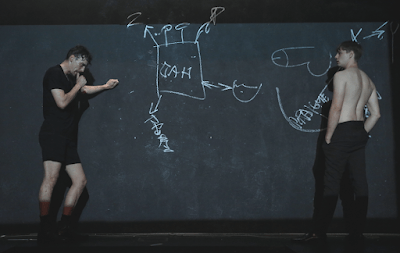
"It's a story about a man running." wrote author Benoit Solès. The first performance in Slovene gives space to a man who ran a marathon with his machine and indispensable friendly minds, a scientist who outlined the foundations of modern computer science and at the same time unknowingly placed a mirror in a society that hopefully will not repeat its impatient and hostile mistakes.
Cast & Creatives
Written by Benoit Solès
Directed by Ivica Buljan
Inspired by: Hugh Whitemore's play Breaking the Code
Based on: Alan Turing: The Enigma by Andrew Hudges
Community Discussion
No comments yet