
About
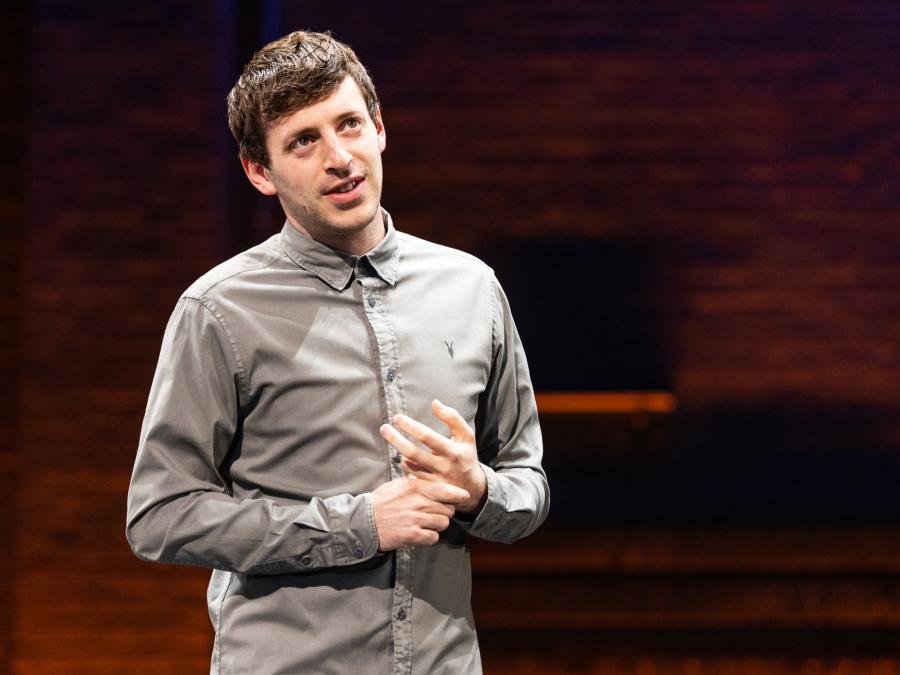
In the wake of a string of anti-Semitic threats pointed in his direction online, standup comic Alex Edelman decides to go straight to the source; specifically, Queens, where he covertly attends a meeting of White Nationalists and comes face-to-face with the people behind the keyboards. What happens next forms the backbone of the shockingly relevant, utterly hilarious and only moderately perspirant stories that comprise Just For Us. Expertly crafted by one of comedy’s most distinctive voices, this singular theatrical experience is an exploration of identity and our collective capacity for empathy — oh, and it’s also “belly-laugh funny!” (The New York Times)
Cast & Creatives
Performed by Alex Edelman
Photos
Community Discussion


If you like the situational and observational humor of John Mulaney, but you wish it had a touch more politics, you don’t want to miss Just For Us. In the 90-minute one man show, Alex Edelman ricochets regularly from self-professed dumb jokes to highly thoughtful observations about race, conflict, and shared humanity in a delightful performance that leaves you both entertained and introspective. Much of the comedy show centers around an experience Edelman had attending a white supremacist meetup in 2017. As he practically runs around the stage spinning out long-winded tangents, you might find the whole thing a bit scattered, but by the time you reach the end he reveals how all the bits and jokes and recollections fit neatly together in a thesis that questions more than it argues. I won’t spoil the main idea, but it’s well worth your time. Although a lot of the humor is centered on Edelman’s Jewish experiences in Boston, New York, and the UK, I rarely felt left out of the joke as someone who’s only Jewish experience as a kid was attending one Bat Mitzvah. Edelman does a great job welcoming you in, explaining details so the whole audience can follow the jokes, without ruining the punchline. He also seems genuinely appreciative of your attendance, and encourages audience members several times to come see him at the stage-door after the show. Overall I think a comedian capable of simultaneously skewering and empathizing with those who are vehemently opposed to his very existence is worth supporting. Amidst all the political unrest in our world, I left Just For Us feeling optimistic about the future, and that is something worth celebrating.

By the end of “Just For Us,” a harsh duality behind the title hits like a brick. Until then, comedian Alex Edelman suggests a single meaning—a show for us, the audience—through everything from a friendly author’s note to riffs with the crowd throughout the performance. Something you may not understand? He’ll ask. A big reaction? He’ll acknowledge it. The more insidious meaning behind the title comes much later. First, the show begins with a self-effacing opener. Edelman offers up two jokes that he admits are beyond silly. And they are. But as the event gradually morphs from self-deprecating standup to harrowing and thoughtful solo show, Edelman pulls off a masterful comedic sleight of hand. In actuality, Edelman’s show retells a night when he decided to go “undercover”—or as undercover as a white but so thoroughly Jewish man can go—to a Neo-Nazi meeting in Queens (Yes, he does point out the irony of it happening in Queens). If the goofy opening disarms the audience, the many tangents give backstory, draw analogies, and simply take the edge off of a capital-w White knuckle tale. One side story about a lesser-known Olympic sport elicits cackles, but also slides head-first into ideas of identity and family connection. As a white Jewish person, I greatly appreciate the nuances the show discusses around navigating—to borrow a meme—“the secret third thing” between privilege and oppression. Edelman’s comedy itself is also VERY Jewish. How so? One of the punchlines is “Baruch Hashem.” But this show saw success in Edinburgh, Scotland—not exactly a Semitic stronghold. The cultural specifics may delight those in the know but still sound fun or enlightening to others. And with its cautionary messaging about the dangers of living in a bubble, the show proves it should never be “just for us.”

Comedian Alex Eldeman's new show on Broadway, "Just for Us," centers around him attending a white supremacist meeting in an apartment in Queens. Eldelman, who is Jewish and therefore "has questions about his whiteness," sourced his own identity history near and far and pulled out 75 minutes of material that's on par with the legends of stand-up. Eldeman's theme is daring yet trite. It's daring because he uses himself as a specimen to examine the limits of empathy and the magnitude of hate, but trite because he is against one of the oldest forms of bigotry existing in US history. On top of all that, Eldeman is also a highly skilled performer. When thinking about great stand-up comedians, they all have their own cadence and rhythm. Mike Birbiglia, Eldeman's mentor, friend, and pioneer of doing stand-up in more uptown theater spaces, always puts his punch on a throwaway line as if it's a mere afterthought. The acid-tongued Anthony Jeselnik has distilled his dark, twisted sense of humor into a pure set-up and punch one-two in his latest special, "Fire in the Maternity Ward." Robin Williams is like a force of nature, Richard Pryor's litany of street words flows in long run-on sentences from a different time and space, George Carlin fires off a machine gun-like barrage of colorful adjectives, and Dave Chappelle, now later in his career, has taken on a more thought-out, sermon-like set-up. Eldeman's style makes the audience think, which is not what people often go to see stand-up for. Before delving into the topic of white supremacists, Eldeman sets his audience up with two jokes, one about a gorilla and Robin Williams, and another about a horse and Whole Foods. Both jokes are what you would call "thinkers" where the punchline is not immediately funny until the listener processes it with their own experiences. Here, Eldeman is leading the audience into a story where the laughs are plenty but the lingering thoughts are nonetheless horrendous. These "thinkers" make up the entire structure of the show, where we laugh through 75 minutes of bone-chilling effects of a thousand years of anti-Semitism. You will come away full of laughter, but something else might stick with you longer, and that's Eldelman's genius (with the aid of the late director Adam Brace, a British one-person show craftsman). His content and form are perfectly in sync here.

A must see