
About
Big Trip marks the full American debut of Dmitry Krymov’s singular theatrical vision. Hailed by The New York Times as “one of the world’s finest theater-makers,” Krymov has developed a new mode of creation – “Theater of the Artist” – in which design elements take on journeys as complex and vivid as those of the characters. In two interconnected parts, Big Trip explores both American and Russian cultures, past and present, through unique theatrical adaptations of some of their most iconic writers: Hemingway, Pushkin, and O’Neill.
Cast & Creatives
Adapted, Written, and Directed by Dmitry Krymov Starring Natalie Battistone, Tim Eliot, Shelby Flannery, Annie Hägg, Kweisiu Jones, Jeremy Radin, Erich Rausch, Jackson Scott, Elizabeth Stahlmann, Anya Zicer
Community Discussion

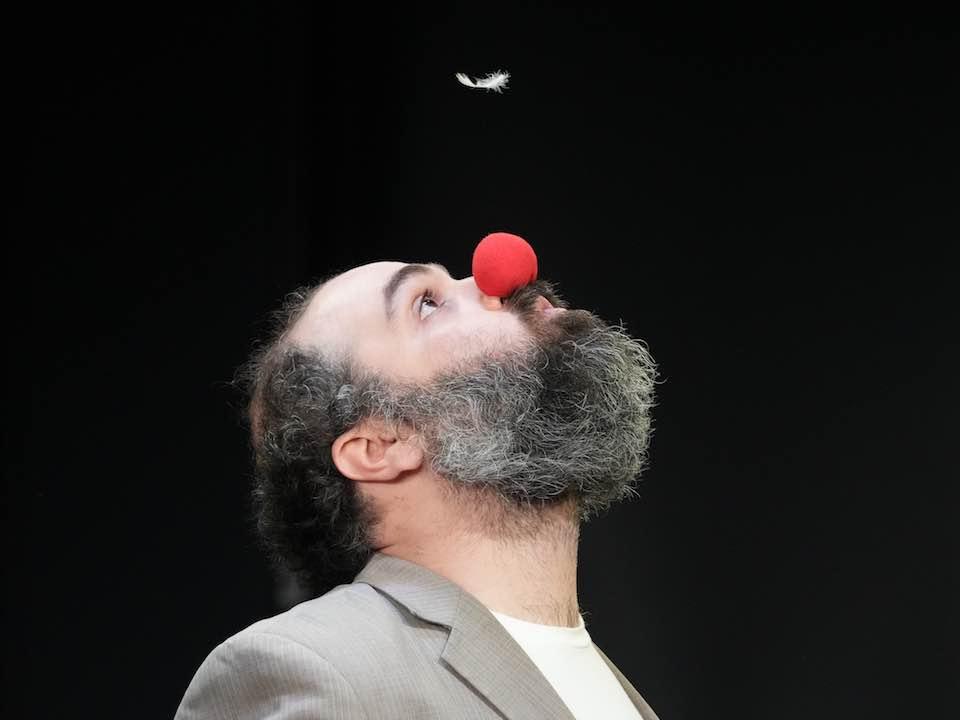
Big Trip 1: Pushkin's "Eugene Onegin" In Our Own Words Dmitry Krymov has been in exile from his homeland, Russia, since the invasion of Ukraine a year and a half ago. A highly acclaimed director whose productions have toured all the famous houses across Europe, his latest work, "Big Trip," arrives at the Ellen Stewart Theatre in La Mama Experimental Theater Club. Though this once-central hub of downtown Avant-Garde theater makers cannot offer the physical grandeur of state-run houses, it allows the piece to burst emotionally into the audiences. Each audience member is asked to bring a "child" with them to watch the show when they enter the theater since "Big Trip 1" is supposed to be a children's show centered around "Eugene Onegin." These "children" are messy-looking dolls carefully constructed with household objects like loose buttons, wooden spoons, and recycled packing paper. (Leah Ogawa and Luna Gomberg are a crafty pair of puppeteers) Controlled chaos seems to be the theme of this production; the show starts with four self-proclaimed as Russian immigrants entering the stage as a traveling circus. Using heavily accented English, they describe Pushkin as the mother of all Russian writers and "Eugene Onegin" as the fountainhead of all Russian novels. It’s such a great piece of work that it "freed" the Russian language, "but it is impossible to translate into English, which itself is already a free language." So these teaching artists set out to use the tradition of "Russian theater" as a way to translate this great text to the children sitting in the audience. After a sharp moment of dissonance, the actors have to lower their stance a little bit. With some carefully plants in the audiences and not so free-willing participation, the show progresses more through the tradition of great clowning, which is never short of in Russian theater history, especially during the Soviet years. Unlike their stoic French counterparts whose physical techniques are now part of every acting conservatory’s syllabus, the Russian clowns seem to focus less on self-control rather than crowd control. The leader of the pack, Jeremy Radin, is a master at toying with the front-row audiences. At the performances I attended, he smoothed over a rift between a cast member and a front-row audience member who is unwilling to participate but fully committed to taking photos on her phone. Radin pushes on with the show as if he is actually performing to a child. With the help of props and chaos, the show proceeds with live theater making rather than the narrative of "Onegin." They were angels and ballerinas, reeds and winters. Almost all vaguely stereotypical Russians are thrown at the audience, all because the performers are set to outdo "Pinocchio" with their great Russian novel. Krymov’s strength as a director and instinct as a designer (Emona Stoykova’s sparce design offers a lot of room to play) is well showcased here; by putting his cast in constant motion and a state of distress, the audience is invited in to discover their emotional state rather than observe. The lanky Jackson Scott does the straight face perfectly, switching seamlessly between a goose and Pushkin’s leading men. Like the stiff upper lips from an Austen novel, here all fever-like emotions are hidden under frenetic actions. More than halfway into the show, the narrative of "Onegin” finally gets going, which at its core is a tragic lover quartet full of jealousy and duels that much mirrors Pushkin’s own life. What’s being unfolded along the double narratives is the theatricality of all; the costumes, the accent, everything is being shed off. The two actresses, Elizabeth Stahlmann and Anya Zicer, transform themselves out of the baggy cloth and slapstick humor to double as the two sisters, protagonists Tatyana and Olga. There was awe from the audiences, generally shocked by their range. The shedding away puts all the previous chaos into sharp focus. Krymov seems to know the "Russian" expectations being placed on his shoulders while working abroad, so he trained a group of American actors to act in a very specific way to fulfill that fantasy. The climax of the show is a dragged out through a clever and classic stage machine, using two convertible belts to highlight the contrast of the micro and macro progression of time. The inevitable sense of loss that's articulated at the end of Pushkin's novel is being demonstrated with frantic impatience. An undeniable and unavoidable sense of nostalgia kicks in, echoing back the title "Big Trip"; Krymov and many other folks from around the world right now are on a journey with no sight of homecoming. And this piece is for all the children who cannot go home. Big Trip 2: Three Love Stories Near the Railroad For the second installment of Russian exiled director Dmitry Krymov's "Big Trip" theatrical ventures, he chooses to use the words of two American male literary giants, Ernest Hemingway and Eugene O'Neill. The piece titled "Three Love Stories Near the Railroad" has interesting conflicts stemming from their original materials. Hemingway's "Hills Like White Elephants" and "A Canary for One" are both lean, punchy, and cold-hearted examinations of impossible heterosexual relationships involving American men who can't confront or communicate their emotions. O'Neill's "Desire Under the Elms," however, is a sprawling trilogy and one of his best efforts to mythologize the birth of America (and American Theater) by imitating the ancient Greeks. As the actor (once again, the straight-faced Jackson Scott is a stiff delight) jokingly introduces at the top of the show, O'Neill's story doesn't even happen around a railroad, "but one is surely nearby." Krymov deals with these materials to him head-on. "Hills Like White Elephants" starts with Shelby Flannery and Tim Elliot as the central couple, and their love and hate duet runs throughout the other two stories. There is still some highly controlled theatrical live-making going on in this piece, with a toy train and a white bucket of paint starting the story (with some of Hemingway's words thrown at the audience). Kewsiu Jones also lends his excellent physicality and flexibility to the piece, but using movement to highlight subtext is a familiar trope, especially on the La Mama stage. However, Flannery's emotional outburst contrasts with Elliot frantically concealing his inner life through movements did offer a nice closure. The gears click in a bit more for "A Canary for One," with a sprawling background operated by Amy Zicer (silent but still every bit as fascinating to watch as she conceals her talent, much like in Big Trip 1) and a comically grand narrative by Jeremy Radin (across the two pieces, he seems to be the most in sync with Krymov’s energy). We are taken on a train ride through Europe, with Annie Hägg starring as an American woman with both the spirit and shape of Liza Minnelli. With less focus on subtext, the piece allows all the actors to have fun, especially Flannery, who shines even just eating bread. For "Desired Under the Elms," Krymov once again sets his male performers with some high physical tasks (You have to pay attention to the scene change and not get distracted by Hägg's excellent Piafesque singing). The sexually charged story arch offers a lot more room for the actors to be naughty. Elliot and Flannery really bring their couple dynamic home in this one, culminating in both a comical and erotic ending. The thread of these love stories is not merely connected by train tracks but by an urge of oppression. Krymov can always mine the power play lying at the core of these stories with hilarious theatricality. One thing that runs through the two parts of Big Trip is the idea of highly choreographed mishaps sprinkled with some theater inside jokes. The actors, with their co-conspirators hiding around the house, achieve these farcical acts very well. It adds to the sense that these shows are put together by amateurs, yet everyone is operating at perhaps the highest level of their game and definitely as one of the finest acting ensembles currently in the city. However, the careful balance struck between emotion and action in Big Trip 1 is less evident in 2. Maybe it's because the shedding of the facade seems more earnest in 1, or maybe it's because Krymov is still trying to sink his teeth into his first bite of the new home turf. The looking back is no more here, only forging ahead however you can, the American way."